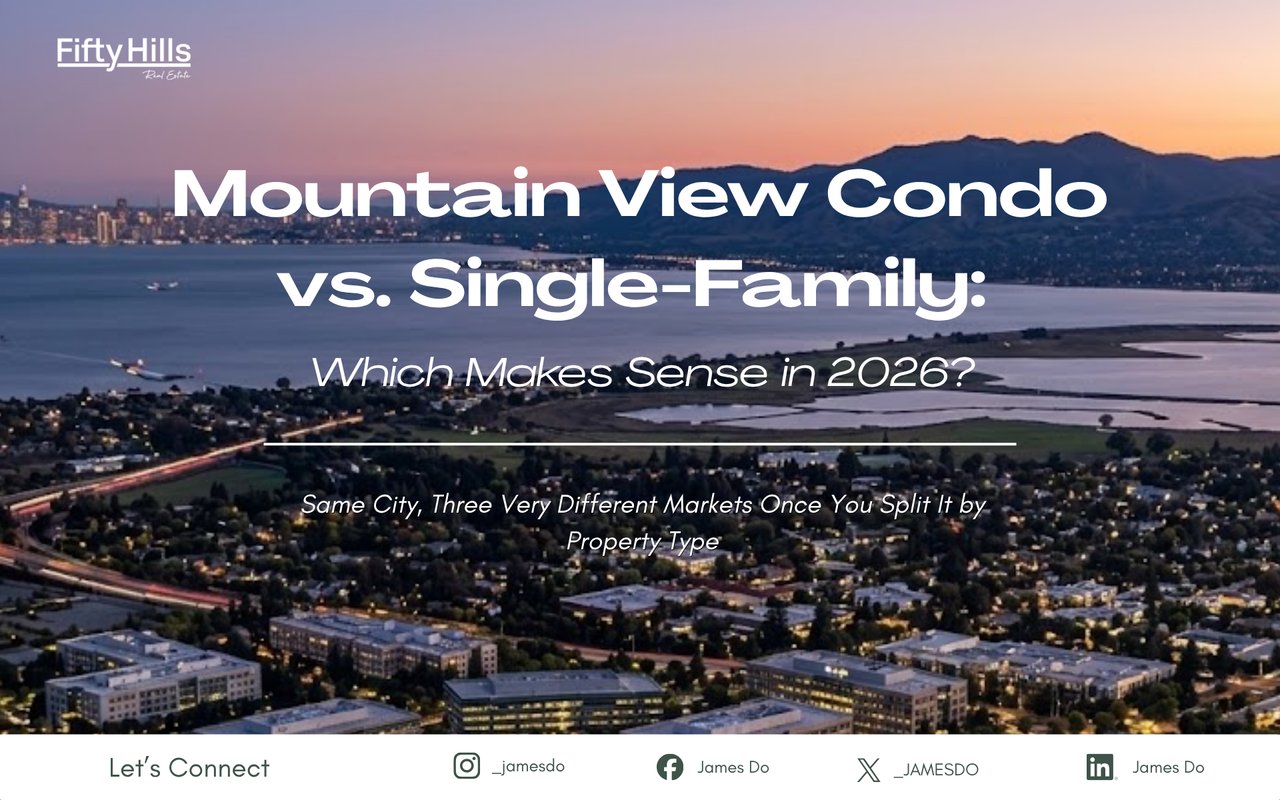
Mountain View isn't one housing market, it's three. Single-family homes are the most competitive segment by far, commonly selling in about a month at a real premium and often above asking. Condos offer meaningfully more inventory and a steadier, less frantic pace. Townhomes, the segment most buyers overlook, are currently showing the clearest discount pattern of the three, with some closing several percent below original list price. If your priority is space and you can compete, single-family is still the goal for most buyers. If your priority is getting in the door at a lower price with real negotiating room, townhomes deserve a much closer look than they usually get.
I walk almost every Mountain View buyer through this exact three-way split, because most people start their search assuming "Mountain View real estate" behaves as one market. It doesn't, and the differences between these three segments are bigger than most buyers expect going in.
How the Three Segments Actually Compare Right Now
Citywide, the blended median sale price across all property types has been sitting around $1.66 million, with broader home value indexes closer to $1.97 million, but that blended number hides just how different these three segments actually behave.
Why Townhomes Are the Segment Nobody Talks About
Most Mountain View content compares condos to single-family homes and stops there. That misses the segment currently offering the most room to negotiate. Recent market data has shown townhomes closing roughly 4% below their original list price on average, a real discount pattern that doesn't show up in the single-family or condo segments right now. If you're priced out of single-family competition but want more space than a typical condo layout, a townhome search is worth taking seriously rather than treating as a fallback.
What to Actually Check Before Buying a Condo or Townhome
Attached housing comes with a layer of due diligence single-family buyers don't have to think about, and skipping it is where I see buyers get burned:
HOA reserve strength — a healthy reserve fund protects you from a surprise special assessment; a thin one is a red flag regardless of how nice the unit looks
Rules on rentals — if there's any chance you'd rent the unit out later, confirm the HOA allows it and understand any rental caps
Recent or pending special assessments — ask directly, don't assume the HOA disclosure package tells the whole story
Insurance coverage gaps — confirm what the master policy covers versus what you'd need your own policy to cover
One local detail worth knowing if renting is part of your plan: Mountain View has its own local rent stabilization ordinance, the Community Stabilization and Fair Rent Act, which applies to many older rental units citywide. It generally doesn't affect an owner-occupied condo or HOA rules directly, but it's a real factor if you're weighing a unit here as a future rental rather than a primary residence.
When Single-Family Still Makes the Most Sense
Despite the premium, I still steer buyers toward single-family when land matters to their long-term plans, room to add an ADU, space for a growing family, or simply wanting full control without an HOA. Mountain View's ZIP codes vary widely on this front. Areas like 94041 have run well above $2 million at the median, while 94040 and 94043 have offered meaningfully lower entry points for the same property type. If single-family is the goal, the ZIP code you target matters as much as the property type itself.
FAQ: Buying a Condo vs. Single-Family Home in Mountain View
Is it cheaper to buy a condo or a single-family home in Mountain View?
Condos generally offer a lower entry point, often in the $1.2M–$1.5M range, compared to $2.5M–$3M for single-family homes in the city's most desirable neighborhoods.
Which property type has the most room to negotiate in Mountain View right now?
Townhomes currently show the most negotiating room, with some recent closings landing several percent below original list price, more than either condos or single-family homes.
Do Mountain View condo HOAs allow renting out units?
It varies by building. Always confirm rental rules and any rental caps directly in the HOA documents before assuming you can rent the unit out later.
Which Mountain View ZIP code is most affordable for single-family homes?
94040 and 94043 have generally offered lower single-family medians than 94041, though pricing shifts by month and specific neighborhood.
Key Takeaways
Mountain View functions as three distinct markets by property type, not one: single-family is the most competitive, condos are steadier, and townhomes currently show the most negotiating room.
Townhomes have recently closed several percent below original list price on average, a discount pattern that doesn't show up in the other two segments.
Always check HOA reserve strength, rental rules, and pending special assessments before buying attached housing here.
If renting the unit out is part of your plan, factor in Mountain View's local rent stabilization ordinance for eventual tenants.
ZIP code matters as much as property type for single-family buyers, with meaningful price gaps between 94041, 94040, and 94043.
If you want a clearer read on which property type and ZIP code fits your budget, reach out, I can walk through the current numbers with you before you start touring.
Sources:
Mountain View, CA Housing Market: 2026 Home Prices & Trends — Zillow Home Value Index
Mountain View Real Estate Market in 2026 — condo, townhome, and single-family price-per-square-foot and days-on-market data
Mountain View CA Housing Market Guide for 2026 — ZIP code-level median price data
Why Buy in Mountain View, CA? What Buyers Need to Know — neighborhood-level single-family and condo price ranges